
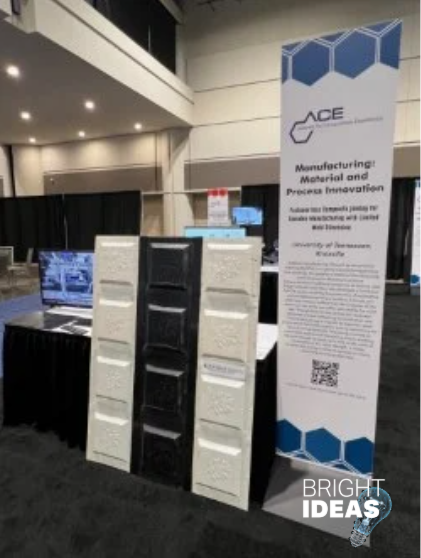
Innovation: Fastener-less Composite Joining for Scalable Manufacturing with Limited Mold Dimension
Award Category: Manufacturing: Material and Process Innovation Award, 2025 CAMX ACE finalist
Company: University of Tennessee, Knoxville (UT) / Oak Ridge National Laboratory (ORNL)
Objective: Additive manufacturing followed by compression molding (AM-CM) is a hybrid manufacturing process that combines the benefits of Additive Manufacturing and Compression Molding to produce high-performance functional composite structures. Oak Ridge National Laboratory has developed an advanced AM-CM system enabling the production of automotive and energy-inspired parts with short cycle time (less than 3-minute) ; however, suffers from the limitation of the maximum size of the part often dictated by the mold size.
Results: Through fastener-less joining, this issue was addressed without hampering the production rate. Fastener-less joining is inspired by Japanese wood joinery which facilitates in-plane joining overcoming the issue of joint eccentricity. This joining is based on macro-level mechanical interlocking theory, enabling the joint strength to reach up to 74% of the material (composites in this case) strength.
Impact: It makes fastener-less joining a material agnostic in nature, underlining its widespread uses.
From the Expert: Vipin Kumar, Senior R&D Scientist at ORNL: “Imagine a continuous stamping process but with thermoplastics. You make a part, print next to it, and press. So, you start growing a part in the X or Y direction as you go. This is important because now you can make a really large composite part with a much smaller capital investment in tooling. That will be particularly helpful for SMEs.”
Akash Phadatare, Graduate Research Assistant at Fibers and Composites Manufacturing Facility, UT: “You don’t need any kind of welding equipment, adhesives, or fasteners to achieve that. I think this method will be helpful for the automotive and high-rate aerostructure sectors as they’re currently looking at technologies that are fast-paced, with cycle times of few minutes.”